Made in Poland
Global Shipping

PS-6TL-250

Compact-Class Hexapod for Flight and Driving Cockpits

A motion range biased toward straight-line travel, tuned for realistic acceleration cues rather than tilt alone, for single-seat training and research cockpits.
26 700*

The list price is the full price of the standard unit shown here - net and ex-works. VAT is normally zero on export orders; options, delivery and any duties are confirmed at order.

6DOF
Degrees of Freedom
250 kg
Gross Moving Load
120/230V AC, 1-phase
Power Supply
Linear Actuator
Technology
Engineered Advantages

Why this model

Three engineering decisions that define this product.

Compact Flight or Driving Cockpit

A 250 kg payload carries a single-pilot cockpit on 230V single-phase mains, not a dedicated three-phase supply.

A clinic or training room installs the cockpit on an existing wall outlet, with no electrical project or contractor.

Three-phase platforms instead add weeks of facility prep and a booked electrician ahead of the first run.
Tuned for Acceleration, Not Just Tilt

A translation-biased envelope reproduces braking and cornering motion as real linear acceleration instead of faking it with angle.

Pilots and drivers feel the linear accelerations they know from the real vehicle, so the trained skill transfers and survives assessment.

A platform short on stroke substitutes tilt for acceleration, a crude motion cue trainees soon learn to ignore.

Shares the Proven QS-L1 Actuator

The same QS-L1 ball-screw actuator runs across this platform, the 6TL-150 and the QS-220, so one part number serves the family.

A multi-rig center stocks one shelf of spares and trains technicians once, keeping every platform serviceable in-house.

Without that commonality, bespoke single-source actuators tie each spare to one supplier and whatever lead time it quotes.

Motion & Dynamics

Technical Data

6DOF
AxisSingle excursionMax excursionVelocityAcceleration
Heave (Vertical)-64.2/+67.4mm-64.2/+67.4mm440mm/s0.31G
Surge (Longitudinal)-85.8/+88.4mm-90/+90mm600mm/s0.41G
Sway (Lateral)-77/+77mm-97/+97mm500mm/s0.36G
Pitch-10.4/+10.3°-13.5/+13.4°60°/s500°/s2
Roll-11.4/+11.4°-11.9/+11.9°80°/s540°/s2
Yaw-11.9/+11.9°-12.1/+12.1°80°/s510°/s2
Payload specifications
Gross Moving Load250kg
Payload250kg
CoG height above MPC<500mm
Moments of Inertia (Ixx, Iyy, Izz)100kg·m2
Main dimensions
Total Width1258mm
Total Length1437mm
Min Height618mm
Max Height750mm
Product Weight213kg
Power & installation
SupplySingle-phase from an ordinary earthed socket - US (120V) or EU (230V) mains.
Network typeStandard one-phase, ground and neutral, RCD-protected.
Circuit protection16A type B circuit breaker (EU 230V).
GroundingStandard protective earth, as on any earthed socket.
InstallationRuns from a compact driver box - no power cabinet, no three-phase feed.
With PS-SB230 (optional)The optional PS-SB230 cabinet runs the platform on 230V single-phase mains; for a 120V supply, contact Technical Support.
Power draw120 V230 V
Average Power0.6kVA0.7kVA
Peak Power1.2kVA1.4kVA
Average Current5A3A
Peak Current10A6A
Avg Power - Stress Test0.3kW0.3kW
Avg Power - Typical Game0.1kW0.1kW
Measured at center of gravity with 250 kg payload Tech Sheet
Motion Envelope

Work Envelope

This chart pairs any two motion axes to show how far they reach together, drawn to scale from the platform's measured limits. Drag the marker anywhere in the plot to read exact values and check whether that pose is reachable.

Surge [mm]Sway [mm]PS-6TL-250
Horizontal axis
Vertical axis
MarkerNeutral
Surge+0 mm
Sway+0 mm

Traced 1:1 from the platform's measured work-envelope plots. The other axes are held at zero.

Software Stack

Native SDK Integration.

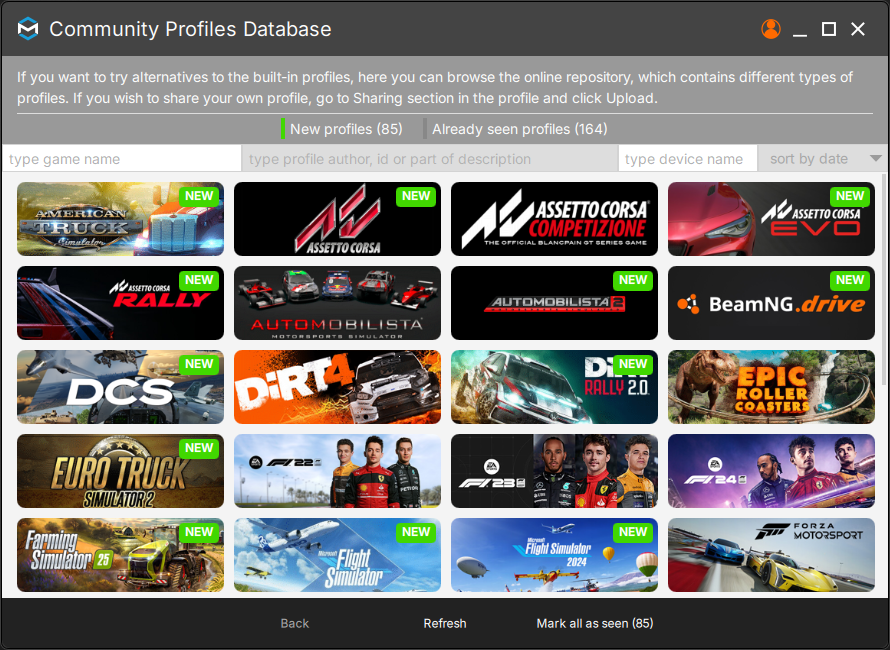
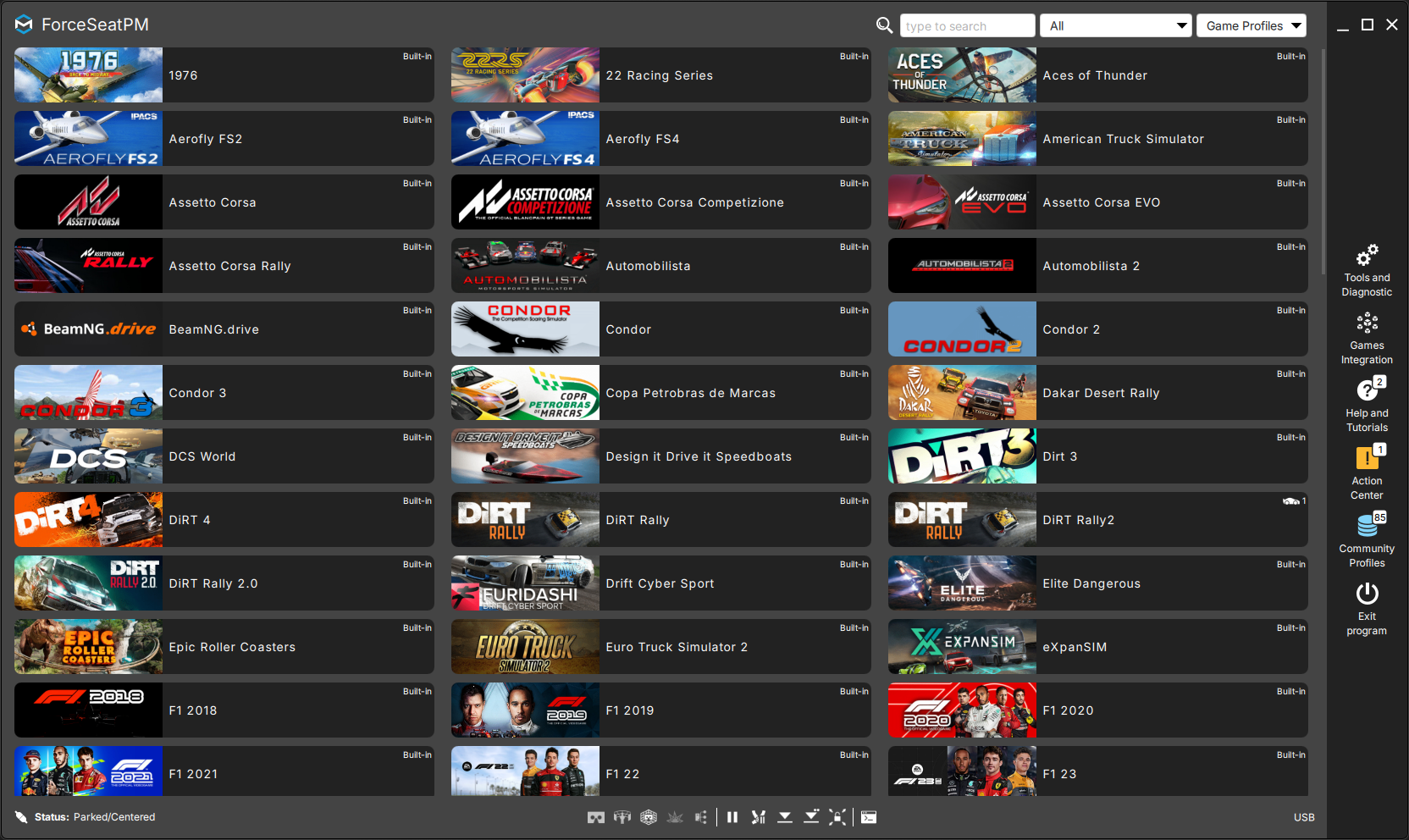
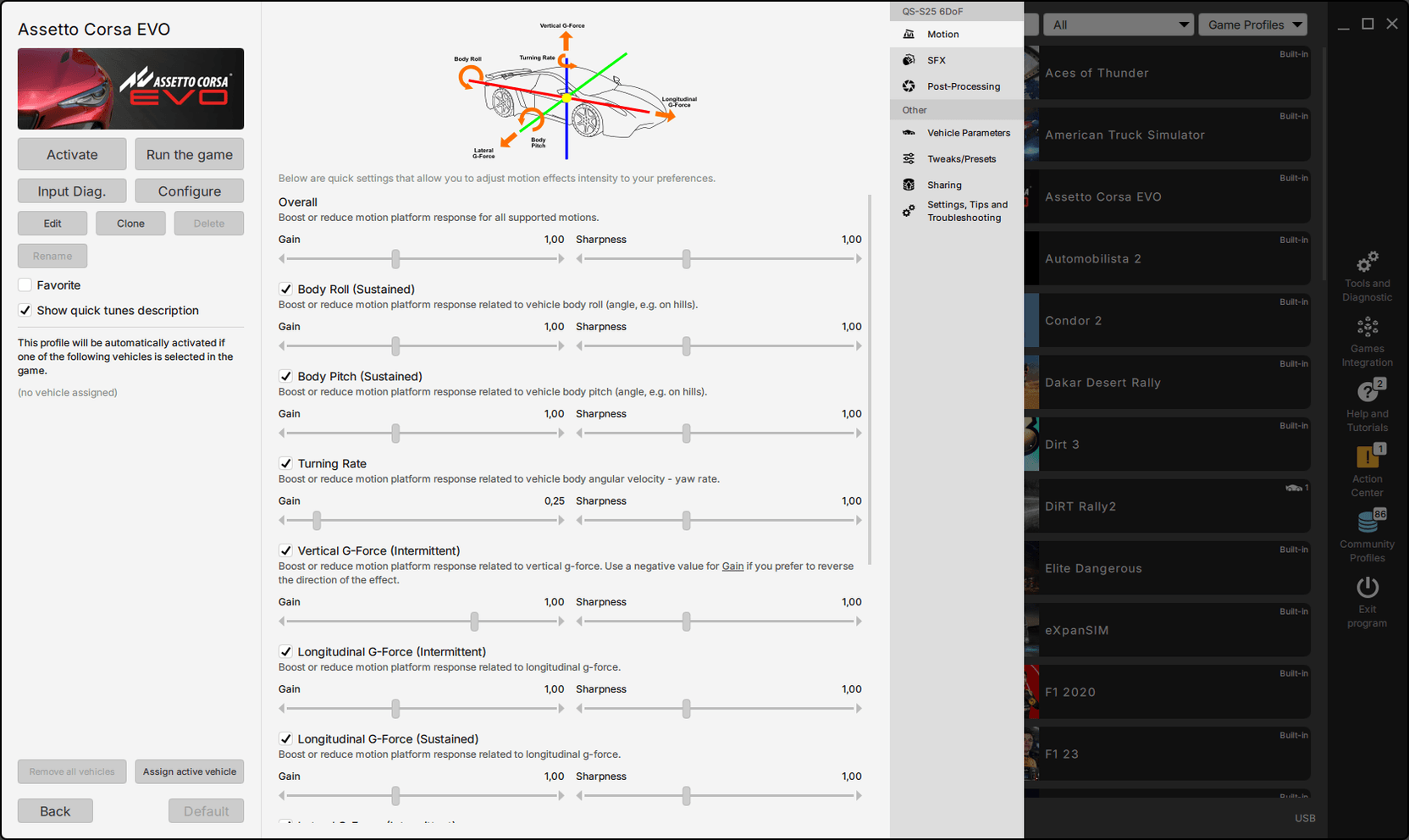
Powered by ForceSeatPM, with 154+ commercial and entertainment simulators supported out of the box. The ForceSeatMI license, held per motion platform with the key on the PC, adds native SDK access for custom logic in C++, C#, Python, Unity and UE5.

Main DashboardGame ProfilesCloud DatabaseDiagnostics
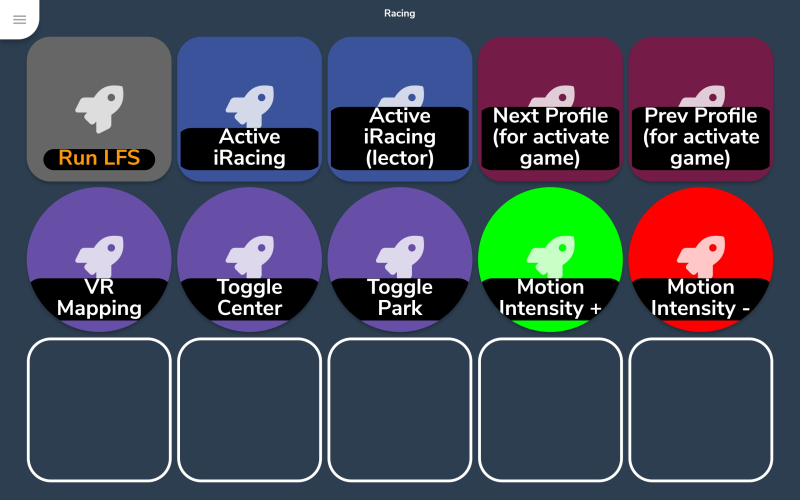
DashboardsDashboards
VR HeadWayVR HeadWay
Control ProtocolControl Protocol
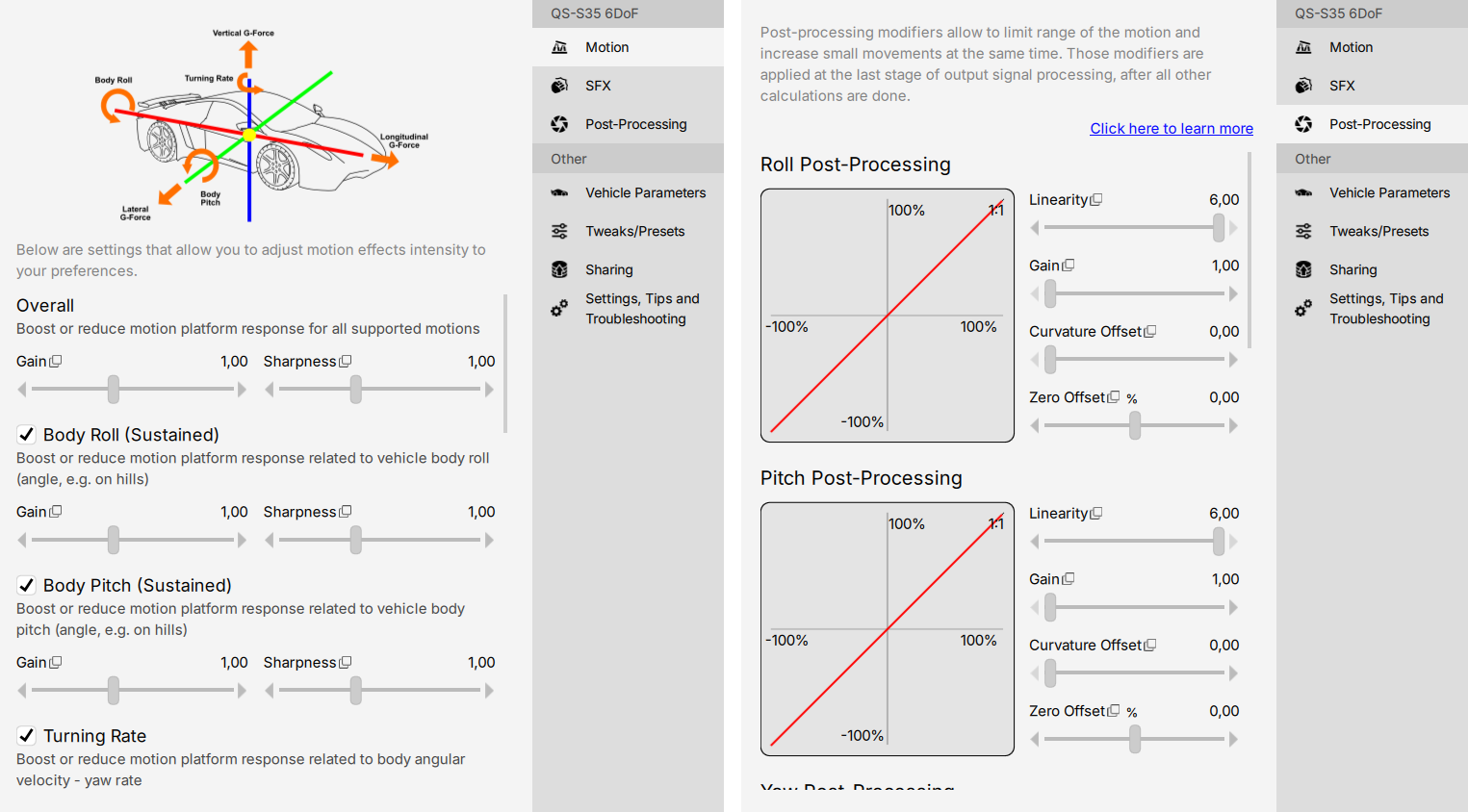
Post ProcessingPost Processing
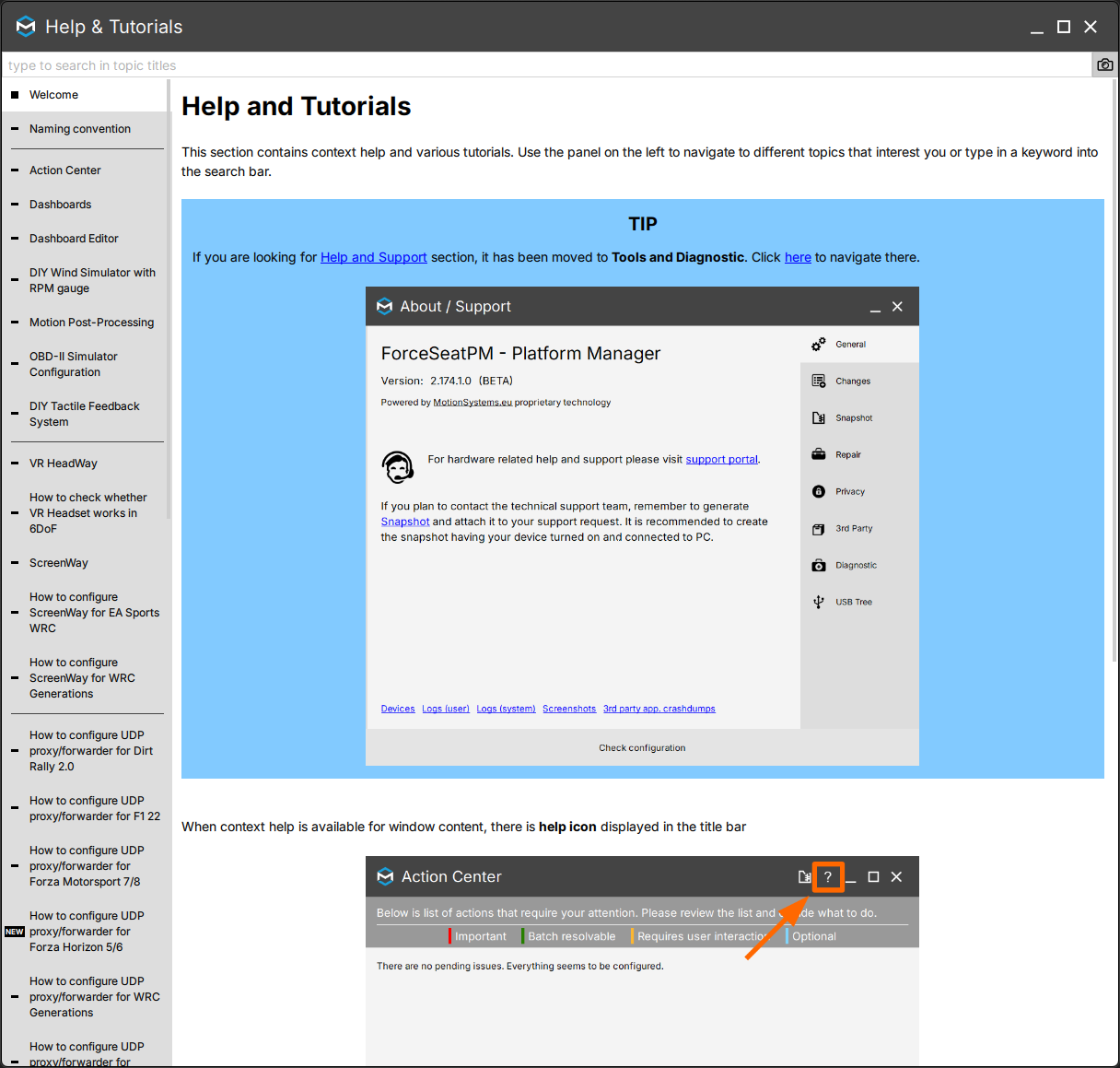
Every ForceSeatPM feature and tutorial is documented in the Knowledge Hub.Browse the tutorials →
Package & Options

What's in the Box.

Hardware, software and licenses included with every unit - plus the optional add-ons available on this model.

Hardware

  • PS-6TL-250
    A compact ball-screw hexapod on six QS-L1 actuators with a larger translation envelope than the 150 - all six axes.
  • Driver Box + Power Supply
    A compact driver box and single-phase supply (120 V US / 230 V EU) run the six QS-L1 actuators from a wall outlet - no cabinet or three-phase.
  • Motion-Lock
    A hardware stop switch - press it and motion cuts at once. With no brakes to hold the load, the platform settles to its lowest resting position.
  • Cable Set
    The USB, power and Motion-Lock cables - the platform wires together as delivered.
  • Packing & Handling
    Ships factory-assembled and calibrated in a forklift-ready crate - the integrator unpacks and installs, with no on-site build.

Software & Licenses

  • ForceSeatPM
    Auto-detects 154+ supported games with pre-tuned profiles. Included free, with free software updates.
  • Sim Profiles
    Pre-tuned motion profiles for the popular sims and games, so the first session already feels right.
  • ACE
    The motion cueing engine that turns simulator telemetry into felt acceleration - the sharp onset of a bend or brake on the platform, with sustained forces held by coordinated tilt rather than a crude static roll.
  • VR HeadWay
    VR motion compensation that cancels the platform's own movement from the headset, so the view stays stable and motion sickness stays low. Included free.
  • Docs & 3D Model
    Full documentation and a simplified 3D STP model, plus the EC Declaration of Incorporation (2006/42/EC) for partly completed machinery - the platform is integrated into a final machine on site.
  • 24-Mo Warranty
    A 24-month warranty on the hardware and motion electronics, with free software updates throughout.

Optional Hardware

  • PS-SB230 Cabinet (E-Stop upgrade)
    Optional, with PS-SBR remote and PS-SBEC button - upgrades Motion-Lock control to a full E-Stop chain. The upgrade is to the stop circuit, not the mechanics: with no holding brakes, an E-Stop cuts the drive and the platform settles to its lowest position rather than holding in place - the same as the standard Motion-Lock. The cabinet runs on 230V single-phase mains; for a 120V supply, contact Technical Support.
    3 900

Optional Software and Services

  • ForceSeatMI - Motion SDK
    Motion SDK to drive the platform from custom software on top of ForceSeatPM. Licensed per motion platform, with the key stored on the PC.
    850
  • ForceSeatDI - Direct Interface SDK
    Low-level SDK that drives the hardware directly, without ForceSeatPM - each platform driven independently, on Windows, Linux or Raspberry Pi. Licensed per platform, with the key stored on the motion controller.
    2 750
  • Remote Training (online)
    Six-hour online session - overview, safety, operation, maintenance, ForceSeatPM setup, diagnostics and tuning. Per session.
    1 800
  • VR HeadWay CrossPC
    A paid VR add-on, licensed separately from the base VR HeadWay. One CrossPC license covers exactly two VR users on a shared platform - each seat has its own rendering PC and geometry-correct compensation (for example pilot and copilot). More seats need an additional license.
    1 900
  • Motion Theater
    Plays pre-authored motion with video or group sessions - for theaters, attractions and briefings, not live sim. Per platform.
    1 300
  • More Options
    Profile packs, installation, reports, extended warranty and bespoke development - talk to the Motion Systems team to tailor it.
    On request
Deep Dive

How It Works.

TL · Linear Hexapod

Six electric ball-screw linear actuators stand in a Stewart hexapod between the base feet and the upper frame, each carried on upper and lower cardan joints. Inside each actuator a servo motor turns a recirculating ball screw, so rotation becomes smooth piston travel; coordinating the extension and retraction of all six legs forms every axis, from heave and surge to pitch, roll and yaw.

The 6TL-250 runs the QS-L1 actuators and plugs into a single-phase outlet (120 V US / 230 V EU), so a compact cockpit installs without a three-phase project. Each actuator's motor encoder reports its extension, so a recorded run repeats the same way for assessment and research.

The Motion-Lock cuts drive, and the frame lowers to its lowest position.

Comparison

Compare Lineup

Side-by-side technical data. Toggle Differences only to highlight the higher values.

Target
PS-6TL-250
Compare with
PS-6TL-350
Specifications
Degrees of Freedom
6DOFPS-6TL-250
6DOFPS-6TL-350
Gross Moving Load
250 kgPS-6TL-250
350 kgPS-6TL-350
Max Payload
250 kgPS-6TL-250
300 kgPS-6TL-350
CoG height above MPC
<500 mmPS-6TL-250
<500 mmPS-6TL-350
Moments of Inertia
100 kg·m²PS-6TL-250
125 kg·m²PS-6TL-350
Power Supply
120/230V AC, 1-phasePS-6TL-250
230V AC, 1-phasePS-6TL-350
Core Technology
Linear ActuatorPS-6TL-250
Linear ActuatorPS-6TL-350
E-Brakes
NoPS-6TL-250
YesPS-6TL-350
Wheels and Feet
NoPS-6TL-250
YesPS-6TL-350
Extended Top Frame
NoPS-6TL-250
Yes (optional)PS-6TL-350
Frequently Asked

Questions the team gets first.

Payload, motion envelope, delivery and software integration - answered up front, ahead of the first call.

The team provides mounting references so the platform drops onto an existing rig. On the software side, the Hardware Imitator M10 - a USB box that mirrors the platform's control interface - is available on request with a first platform order that includes a ForceSeatMI or ForceSeatDI license, and it comes with a 6-month SDK license so the software team can validate integration before delivery. Custom integration runs through the ForceSeat SDK with motion profiles set in ForceSeatPM; where a build calls for it, the engineering team handles any platform firmware changes.

Platforms run on the ForceSeat software stack: ForceSeatPM delivers out-of-the-box support for popular simulation titles, and the ForceSeatMI and ForceSeatDI SDKs expose a documented API for custom telemetry in C, C++, C# and Python, plus plugins for Unity and Unreal Engine.

Yes, on three levels. The catalog spans payload classes from compact cockpits to full-cabin builds, so most projects start with the right standard model and a payload reserve. For oversized cockpits and cabins, the motion envelope and dynamics are then matched to the load - in software on every platform, and with adjustable hardware travel limiters on selected higher-payload models. Where the catalog does not fit, a bespoke build scopes payload, envelope and travel. Share the intended payload, its mass and the motion requirements and the team will confirm the right configuration.

Delivery includes installation guidance that specifies the mounting points and the power and electrical setup per model; site preparation, floor requirements and platform anchoring are the integrator's responsibility. Every platform ships factory-tested and arrives ready for integration into the simulator build.

Professional Series platforms are built to order, typically in 6-10 weeks from payment, with the exact schedule confirmed at quote. With the optional Hardware Imitator M10, software integration runs in parallel with production, so go-live is not gated by delivery. The compact Qubic System line is often in stock and typically ships within 1-3 weeks.

Every Professional Series platform ships with a 24-month warranty, extendable by agreement. Spare-parts manufacturing and diagnostic support continue for the operational life of the platform, with SLA options for fleet and training deployments.

Integrate the PS-6TL-250 into the project.

One team scopes the build, carries it through integration and commissioning - with integrator partners where a full simulator is the goal - and stays involved once the rig runs in the field.

What happens next?

< 1 business day

Confirmation & initial review

A dedicated account manager reads the message directly.

2-3 business days

Technical assessment

The team analyzes feasibility and prepares questions or an initial concept.

5-10 business days

Proposal delivery

Detailed technical proposal with a platform recommendation, transparent pricing, lead time, and integration timeline.

Ongoing

Team support

Ongoing support from the team behind the recommended platform - for the life of the project.